


Published: December 15 2025
This blog post discusses quality assurance for semiconductors.
One day, Rookie D, in her second year with the company, came to Senpai C, a senior veteran, with a worried look…
* Senpai: A Japanese-style title to show respect to those older than oneself, especially used in organizations such as companies, schools, etc. It sometimes implies that the psychological relation between the two is closer than that between a boss and a subordinate.
Table of Contents
Reliability?
What Is a Bathtub Curve?
Identifying and Removing Potential Early Failures through Screening
Reliability Test to Ensure Products Don’t Enter the Wear-Out Phase
Help Me, Senpai! Series Vol. 8
Quality Assurance for Semiconductors—and What’s the Bathtub Curve?
 Rookie D
Senpai C, what is quality assurance for semiconductors?
You explained AEC-Q100 to me the other day, but there are other things too, right? I want to take this chance to really learn things properly.
 Senpai C
Hmm… it’s good that you want to study, but explaining things can be pretty tough.
 Rookie D
Don’t say that. Please teach me, Senpai!
Senpai C
Right. Quality assurance is handled by the QA department, but the field is deeper than it seems. This time, let me explain the basics.
 Rookie D
Yes, please!
Reliability?
Senpai C
Quality assurance is all about improving product reliability. Do you know what we mean by “reliability”?
 Rookie D
Does reliability simply refer to products functioning without failure?
Senpai C
Right. Reliability refers to the likelihood that products will operate properly. However, since products sometimes fail, manufacturers work hard to make products less likely to fail. Products that are less prone to failure are considered highly reliable.
Product failures can be categorized into three types: early failures, random failures, and wear-out failures.
As you might guess from the terms, early failures occur relatively quickly due to inherent defects. Wear-out failures occur as components age and eventually fail. That corresponds to the end of the product’s lifespan. Random failures occur in the period between those two.
The graph that shows how the failure rate changes over time during the product’s operating life is called the “bathtub curve.” It is named because its shape resembles the cross-section of a bathtub when viewed from the side. It’s also referred to as a “failure rate curve.”
What Is a Bathtub Curve?
 Senpai C
The bathtub curve illustrates how failure rates change throughout a product’s lifetime. In the initial portion of the curve, known as the early failure phase, the failure rate begins high but quickly declines and stabilizes. The flat middle section represents the random failure phase, during which failures occur randomly at a nearly constant rate over time. Finally, in the wear-out phase, the failure rate rises sharply as components reach the end of their lifespan and become more prone to failure. This characteristic shape resembles the cross-section of a bathtub, which is why it’s commonly called the “bathtub curve.”

Figure 1. Bathtub curve (failure rate curve)
Senpai C
Semiconductor components are somewhat special because they have no mechanical moving parts, which means there are very few failure mechanisms. This is why they are often said to basically never fail. Their random failure phase is so long that it exceeds the lifespan of the system.
By the way, this assumes the components are properly mounted on the board, so don’t be confused. This doesn’t apply to semiconductor components that have been stored for many years. Just to mention briefly, if semiconductor components are stored for a long time, their terminals can start to corrode. You might not notice it because it doesn’t turn bright red like iron, but corrosion means oxidation, so a thin oxide film forms on the terminals. This leads to poor solderability and can result in improper mounting on the board.
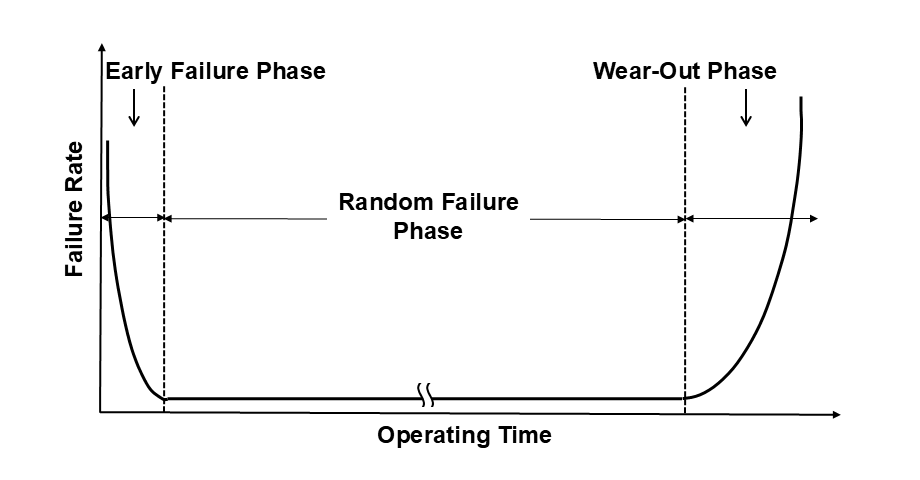
Figure 2. Bathtub curve for semiconductors (failure rate curve)
 Rookie D
But saying they never fail is impossible, right? (laughs)
Senpai C
Well, yes (wry smile). Random failures aren’t zero. As this figure shows, there are initial failures. A screening test is performed to remove them. Reliability tests are done to make sure semiconductor components don’t reach the wear-out phase before the system itself reaches the end of its lifespan.
Identifying and Removing Potential Early Failures through Screening
 Rookie D
Specifically, what do we do?
Senpai C
First, screening is performed during the outgoing inspection, where every unit is tested. Since running them for the equivalent time of the early failure phase is impractical, an accelerated test is performed under tough conditions. This accelerated stress test reveals potential failures in a very short time, screening them out. This approach reduces the likelihood of initial failures in the market to nearly zero. Of course, electrical characteristics are also tested on every unit during the outgoing inspection.
 Rookie D
I see. So, components that seem likely to fail soon after going to market are intentionally failed and removed during outgoing inspection. But running such a stressful test, wouldn’t even the good components be considered used ones?
Senpai C
It’s true they won’t be brand new anymore. But it’s just for a very short time. As I mentioned earlier, semiconductor components have an extremely long random failure phase, so the time difference is negligible. Which would you prefer: brand-new ones that might fail, or almost-new ones that have been lightly tested and are very unlikely to fail?
Rookie D
Yes, I’d prefer the “almost brand-new” ones that hardly ever fail. It’s more reassuring. (laughs)
Senpai C
If screening is performed, the resulting bathtub curve would look like this. It looks less likely to fail, doesn’t it? Much more reliable, right? Pretty impressive, huh?
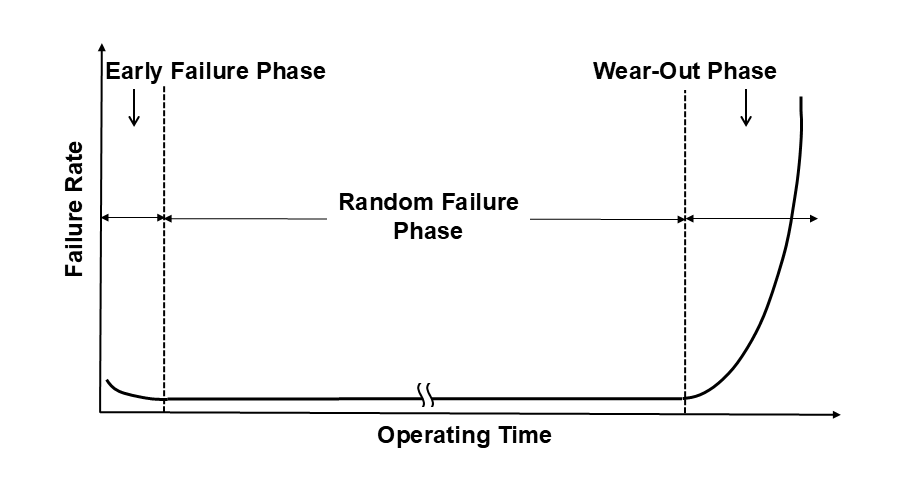
Figure 3. Bathtub curve for semiconductors after screening (failure rate curve)
 Rookie D
Oh, yes. That’s true. (laughs)
Reliability Test to Ensure Products Don’t Enter the Wear-Out Phase
Senpai C
Let me explain one more thing about reliability tests. It confirms that components won’t fail before the system reaches the end of its lifetime, usually assumed to be about ten years.
 Rookie D
Well, if it runs for ten years, that should be more than enough, right?
Senpai C
Really? I thought you’d say, “Ten years sounds short.” But that’s the cumulative operating time, not ten years of continuous operation. You don’t use a normal product 24 hours a day, 365 days a year, do you? You wouldn’t turn on your air conditioner or TV and leave them 24 hours a day, would you? The product’s ten-year cumulative operating time actually equates to a much longer period than just ten years. Standards such as JEDEC and AEC-Q100 specify this, requiring accelerated tests under defined conditions such as high temperature, high humidity, high pressure, or high voltage over a defined period. Of course, the duration and acceleration conditions vary depending on the product and standard.
 Rookie D
I see. But running a reliability test for something like 1,000 hours, unlike screening, wouldn’t that make them seem almost used instead of brand new?
Senpai C
Right. That’s why reliability tests use sampling instead of testing every unit to ensure that no failures occur during the wear-out phase of the bathtub curve. Therefore, wear-out failures don’t occur in the market.
 Rookie D
Shouldn’t that kind of data be available to the public?
Senpai C
The estimated failure rates are properly disclosed.
Rookie D
The product’s reliability is ensured through screening and reliability tests, right?
Senpai C
Of course, this assumes that the specifications are properly verified during outgoing inspection.
 Rookie D
Yes, I understood very well. Thank you very much.
Learn more about quality and reliability at Nisshinbo Micro Devices here.
Learn more about reliability test specifications (electronic device products) at Nisshinbo Micro Devices here.
Afterword
This is the eighth blog post introducing how our products can help you.
If you have any questions about this blog, feel free to contact us below.

Click here to read the previous blogs in the “Help Me, Senpai!” series:
Vol. 1: IoT for Energy Harvesting: Solar Panel Can’t Drive System till Morning
Vol. 2: Stop Sleeping Mobile Device from Consuming Battery Charge!
Vol. 3: RTC Backup Switchover Circuit Is Not Easy.
Vol. 4: What Is AEC-Q100?
Vol. 5: Buy Samples Online - No Sales Pressure Involved
Vol. 6: How do I Use This Type of Reset IC? (What is Functional Safety?)
Vol. 7: Why Not Just Eliminate Flicker?—Exploring Analog (Linear) Dimming
Blogs about quality assurance and reliability:
Vol. 4: What Is AEC-Q100?


Comment