

Published: November 27, 2025
Updated: September 3, 2026
This blog post discusses countermeasures for preventing flicker in lighting fixtures.
One day, Rookie B, in his third year with the company, came to Senpai* A, a senior veteran, with a worried look on his face......
* Senpai: A Japanese-style title to show respect to those older than oneself, especially used in organizations such as companies, schools, etc. It sometimes implies that the psychological relation between the two is closer than that between a boss and a subordinate.
Table of Contents
What Is Flicker?
Persistent Flicker Caused by Dimming Control
High-Frequency Flicker Countermeasures
Why Not Just Eliminate Flicker?
ICs Enabling Analog Dimming with PWM Input
Achieve Nightlight with Dimming Down to 0.5%!
Color Reproduction Range Expands When Dimmed to 0.5%!
Not Only for Consumer Use, but Also Available in Industrial and Automotive Grades!
Help Me, Senpai! Series Vol. 7
Why Not Just Eliminate Flicker?—Exploring Analog (Linear) Dimming
 Rookie B
Senpai A, I thought flicker countermeasures had been progressing recently, but are they still not sufficient?
|
|
|


 Senpai A
No, I don’t think so. Nowadays, digital cameras and smartphones are equipped with flicker reduction functions, and dashboard cameras are responding by changing their frame rates.
 Rookie B
However, I still sometimes see banding caused by flicker in the videos I take.
What Is Flicker?
Senpai A
Flicker is fundamentally caused by the frequency of alternating current (AC) power. Flicker occurs 100 times or 120 times per second when the AC power frequency is 50 Hz or 60 Hz, respectively. It’s not noticeable to the human eye, but when using a camera, bright and dark images may be captured in photographs, and banding may appear in videos depending on the cycle. If the frame rate of dashcam and AC frequency are synchronized, the traffic lights may appear black, making it impossible to tell if they are red or green.
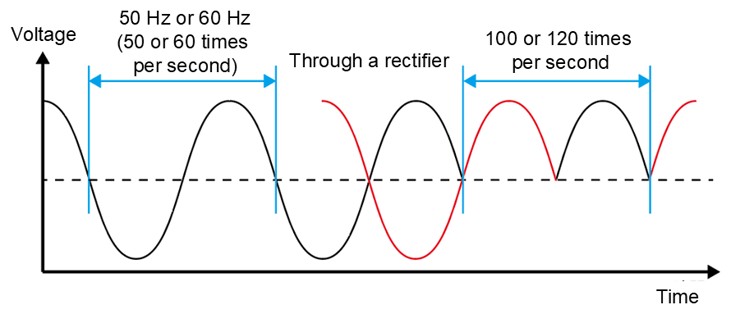 Figure 3. Relationship between AC frequency and flicker
Rookie B
Huh? LEDs run on direct current (DC) power, right?
Senpai A
However, it originally runs on AC power. With the exception of items like battery-powered LED flashlights, LED lighting uses AC power that is converted to DC via a rectifier circuit. So, it’s affected by fluctuations in AC frequency to some degree. This is called pulsating direct current or pulsed DC.
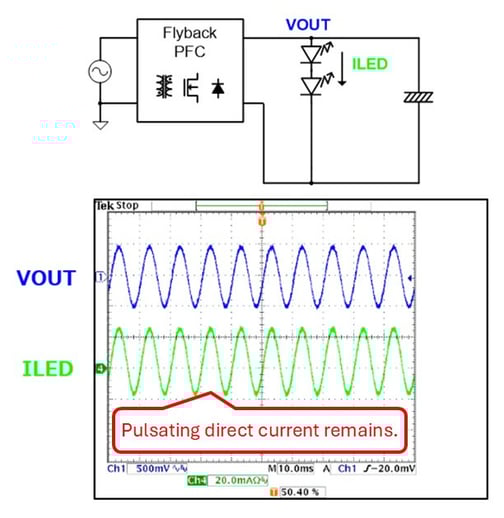
Figure 4. Pulsating direct current remains in the LED current
Rookie B
However, the frequency is fixed with AC power, so we can counteract it with features like the flicker reduction and frame rate adjustment we mentioned earlier.
So why are countermeasures overlooked?
Senpai A
Well, that’s because it’s under dimming control.
Persistent Flicker Caused by Dimming Control
 Rookie B
Dimming?
Senpai A
Originally, flicker was present not only with LED lighting but also with fluorescent lamps. However, as fluorescent lamps evolved into inverter types, flicker was greatly reduced. This is because they convert AC power frequency to a much higher frequency, about 1,000 times higher.
Rookie B
Yes. What is it?
Senpai A
Old fluorescent lamps only had on-and-off settings. Household fluorescent lamps with double rings could adjust brightness by lighting the inner ring, outer ring, or both. However, linear fluorescent lamps in offices only had on-and-off settings. Dimming allows brightness to be freely adjusted, and the brightness is changed by varying the lighting duration. This switching is carried out using the inverter’s high frequency.
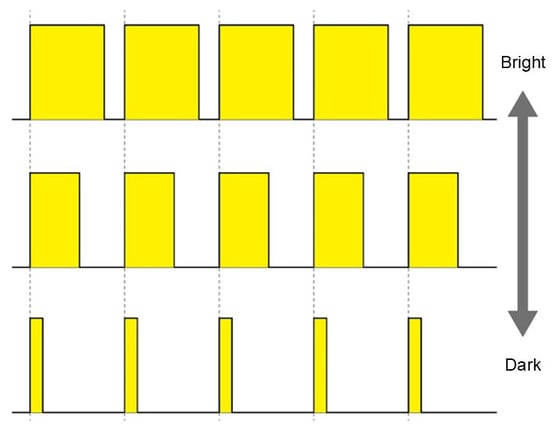 Figure 5. Changes in lighting duration and brightness
 Rookie B
I see. So, it adjusts the brightness by rapidly switching the lighting on and off.
Senpai A
That’s right. LED lighting works the same way. It adjusts brightness in steps or continuously by changing the ratio of the LED ON and OFF time. This ratio is called the duty cycle. Furthermore, LED lighting can even change colors by using red, green, and blue LEDs. This kind of color tuning isn’t possible with fluorescent lamps, but it is possible with LED lighting.
Note: One dimming method involves changing the number of active LEDs, such as 10 for bright, 5 for medium, and 2 for dim. However, this method is simple and does not allow for continuous dimming.
 Figure 6. Color shift with RGB (color tuning)
High-Frequency Flicker Countermeasures
Rookie B
I see. I understand about dimming, but is that related to flicker?
Senpai A
Since the frequency of AC power is constant, the necessary countermeasures are simple. However, the on-and-off cycle for dimming LEDs at high frequencies varies depending on the lighting fixture. This is why countermeasures are difficult.
Rookie B
What you’re saying is that it can’t be countered in the same way as flicker caused by the AC power frequency, right?
Senpai A
Yes, that’s correct. Of course, each company is improving its countermeasures. For example, camera flicker reduction functions not only synchronize the shutter speed or frame rate with the AC frequency but also seem to synchronize with the on-and-off cycle of lighting fixtures. This became possible once electronic shutters were introduced, as they allowed fine adjustments to the shutter speed.
In other words, the camera’s sensor detects the flicker cycle of the LED lighting and opens the shutter when it is synchronized with the lighting. This ensures that photos are not dark and that banding caused by flicker does not appear in the image.
Why Not Just Eliminate Flicker?
Senpai A
Well, that said... since it’s actually flicker “reduction,” completely eliminating flicker under all conditions is difficult.
After all, a room usually doesn’t have just one light; in many cases, different types of lighting fixtures are used together. Live houses might be an extreme example, but most event venues have a variety of lighting fixtures. With mixed light sources, both the color temperature and the dimming cycle (or on-and-off cycle) of lighting fixtures become issues. Even if it’s not noticeable to the human eye, it causes problems for cameras.
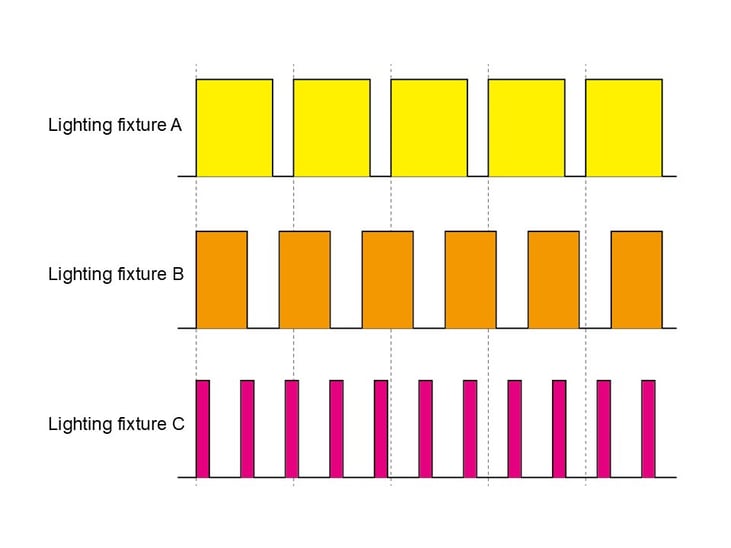 Figure 7. Dimming cycles vary depending on lighting fixtures
So, today’s theme is to fundamentally solve this problem by creating LED lighting that doesn’t flicker.
 Rookie B
Is that even possible? By the way, that's way too long for an introduction.
Senpai A
The point is that it would be better not to turn the LED on and off at all. This method of adjusting brightness by turning the light on and off, in other words, dimming by adjusting the on-to-off time ratio (duty cycle), is called pulse width modulation (PWM) dimming. In contrast, there’s also analog (linear) dimming.
Analog dimming keeps the LED on at all times and adjusts its brightness by increasing or decreasing the current flowing through it. Increasing the current makes the LED brighter, while decreasing the current makes the LED dimmer.
 Rookie B
That’s a great idea! Why doesn’t everyone do it?
Senpai A
Everyone wants to do it, though. In order to achieve analog dimming, an analog signal needs to be input, right? However, generating an analog signal is a complicated process. It requires components such as operational amplifiers and digital-to-analog (DA) converters, which make the circuitry complex.
 Rookie B
Ugh… Does that mean it can only be used for high-end LED lighting or professional applications?
ICs Enabling Analog Dimming with PWM Input
Senpai A
This is where the R1580N series from Nisshinbo Micro Devices comes in.
This IC is unique in that it uses a PWM signal for analog dimming. It requires just a few peripheral parts.
 Rookie B
Huh?
Senpai A
The R1580N is an LED driver controller IC and does not have an internal FET. However, since the required maximum voltage for the FET varies depending on the number of LEDs used, you should select one that suits your needs. The other necessary external components are resistors and capacitors. In this block diagram, changing the duty cycle of the PWM signal applied to the DIM pin can increase or decrease the LED current. Since LED brightness can be adjusted linearly with LED current, flicker is physically impossible.
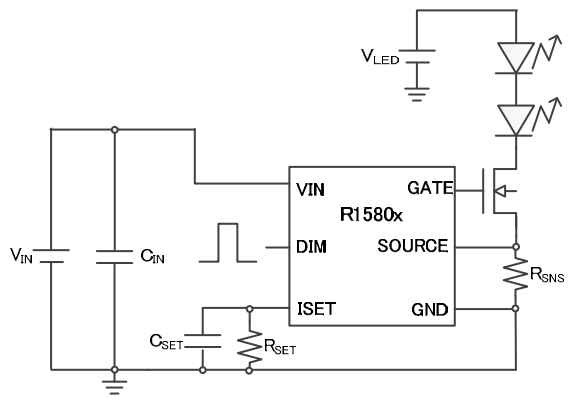 Figure 8. R1580NxxxA basic circuit example
Rookie B
A simple circuit can achieve flicker-free operation, right?
Achieve Nightlight with Dimming Down to 0.5%!
 Senpai A
The R1580N’s feature isn’t only its ability of analog dimming with a PWM signal.
The typical dimming range for LEDs is usually from 5% to 100%, so it’s not possible to make them dimmer than that. However, with the R1580N, you can. More impressive, its dimming range is incredibly wide, from 0.5% to 100%. See. 5% and 0.5% are completely different.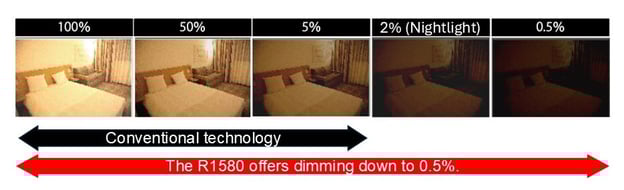
Figure 9. Dimming range using the R1580N
 Rookie B
That’s true. With the brightness set to 0.5%, I could probably sleep with it on.
Senpai A
Furthermore...
Rookie B
Is there more to come?
Color Reproduction Range Expands When Dimmed to 0.5%!
Senpai A
LED lighting can produce any color by mixing red, green, and blue, right? If each color can be dimmed down to 0.5%, the color reproduction range expands significantly. This not only widens the range of color reproduction but also makes color transitions incredibly smooth because it’s analog dimming.
Here is an example using two colors: red and blue LEDs. The office lighting can also be dimmed to match the natural light outside, depending on the time of day.
 Figure 10. Brightness and color adjustment for office lighting with two-color LEDs
Rookie B
Using two colors creates this effect. Using three colors would result in incredibly stylish lighting. It’s perfect for event venues.
Senpai A
Plus, since there’s no flicker, it’s also perfect for indoor sports venues.
In sports, there’s a lot of fast motion, so you want to freeze the action with a high-speed shutter—but at 1/100 second the images still blur.
It could also be great for light fixtures around security cameras or for LED traffic lights. If the lighting doesn’t flicker, moving objects won’t blur, and traffic signals will show their proper colors instead of appearing black.
By the way, using two R1580Ns in series allows for even finer dimming, starting from as low as 0.05%.
Rookie B
Um, that far isn’t necessary.
Senpai A
Indeed. For more details, please contact us here (laughs).

Rookie B
Please feel free to contact us.
Not Only for Consumer Use, but Also Available in Industrial and Automotive Grades!
Senpai A
Oh, I forgot to mention that. The R1580N is available not only in consumer grade but also in industrial and automotive grades.
Rookie B
Huh. So, it can be used for LED accessory lamps in cars, right? And if it’s used for factory lighting, cameras monitoring the production process won’t capture flicker, right? Got it.
Rookie B
The R1580N is available in three versions: 001A, 002A, and 003A. Evaluation boards for each version are available from online retailers. Please evaluate them. Thank you for your consideration.
The R1580N evaluation boards are available for purchase from online retailers.
(Clicking the logo will open each retailer’s sales page)
R1580N001A-0020-EV R1580N002A-0020-EV R1580N003A-0020-EV Please feel free to contact us.


For more information about the R1580N, click here.
The PDF white paper, the Quick Reference Guide for the R1580N, will open.
Afterword
This is the seventh blog post introducing how our products can help you.
If you have any questions about this blog, feel free to contact us below.
Click here to read the previous blogs in the “Help Me, Senpai!” series:
Vol. 1: IoT for Energy Harvesting: Solar Panel Can’t Drive System till Morning
Vol. 2: Stop Sleeping Mobile Device from Consuming Battery Charge!
Vol. 3: RTC Backup Switchover Circuit Is Not Easy.
Vol. 4: What Is AEC-Q100?
Vol. 5: Buy Samples Online - No Sales Pressure Involved
Vol. 6: How do I Use This Type of Reset IC? (What is Functional Safety?)
Vol. 7: Why Not Just Eliminate Flicker?—Exploring Analog (Linear) Dimming
Vol. 8: Quality Assurance for Semiconductors—and What’s the Bathtub Curve?
Vol. 9: How to Safely Remove Semiconductor Components—Handle with Care


Comment