


Published: May 7, 2026
Two posts ago, I mentioned that advanced logic semiconductors are the product category in which horizontal specialization has progressed the most among various types of semiconductor products. I briefly explained advanced logic semiconductors, but there are several similar terms with ambiguous definitions. I myself did not have a clear understanding, so I decided to look into them again. I will now share the results of my research with you.
Table of Contents
The Roots of Logic Semiconductors: The Study of Logic and Logic Semiconductors
Definition and Types of Logic Semiconductors
Advanced Logic Semiconductors
Volume 19: Miniaturization and Horizontal Specialization in the Semiconductor Industry (Special): Roots, Definitions, and Types of Advanced Logic Semiconductors
The Roots of Logic Semiconductors: The Study of Logic and Logic Semiconductors
As I explored advanced logic semiconductors, my investigation eventually led me back to the academic study of logic. Let me begin with the roots of logic semiconductors.
Logic is an academic discipline that studies human thought. It examines rational thinking and methods of reasoning.
Logic is generally said to have originated in ancient Greece as a branch of philosophy. Although it is believed to have stagnated during the Middle Ages, the 19th century saw the emergence of mathematical logic, also known as symbolic logic, which made it possible to treat logic in mathematical terms.
In mathematical logic, the truth or falsity of propositions is expressed using “1” for true and “0” for false, and their relationships can be described mathematically. Logical operations are those that correspond to the four basic arithmetic operations in ordinary calculation. The three fundamental logical operations are AND, OR, and NOT. AND is called logical conjunction and corresponds to multiplication, while OR is called logical disjunction and corresponds to addition.
In the 1930s, it was demonstrated that such logic operations could be represented using electrical circuits (switches) by assigning the on and off states of switches to 1 and 0. This development, known as switching circuit theory, preceded the invention of the transistor by more than a decade, so relays were used as the switching elements. Looking back, the idea may seem obvious, but it was considered a major breakthrough. Through this discovery, logic, which had become connected to mathematics, also became connected to electricity.
Note: The founder of switching circuit theory is considered to be the American Claude Shannon, known as the “father of information theory.” However, shortly before Shannon presented his work in “A Symbolic Analysis of Relay and Switching Circuits” (master’s thesis, 1937; journal publication, 1938), Akira Nakajima and his colleagues in Japan had already published papers on the same subject.
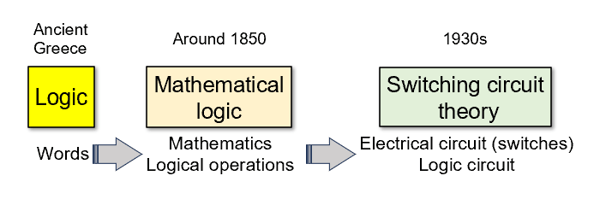
The connections among logic, mathematics, and electricity
A logic semiconductor is an integrated circuit (IC) that implements those electrical circuits, that is, logic circuits. After the invention of the transistor, logic operations were implemented as electronic circuits using transistors. When integrated circuits were invented in the late 1950s, these logic circuits came to be implemented as integrated circuits in the early 1960s. These are called general-purpose logic ICs or standard logic ICs, and they are still manufactured and sold today.

Implementation of logic circuits as integrated circuits and the emergence of logic semiconductors
The key point here is that if numbers are represented in binary—that is, using 1s and 0s—then the four basic arithmetic operations can be carried out using logic operations. Addition of two numbers is the process of assigning a single output value to each possible combination of the two numbers (as shown in the table below). This corresponds to what is known as a truth table in logic. Every truth table can be expressed as a combination of basic logic operations. In other words, addition can be expressed in terms of logic operations. Since subtraction, multiplication, and division can be constructed from addition, all four arithmetic operations can be implemented using logic operations. As mentioned above, logic operations can be implemented using integrated circuits. In other words, calculating machines can be built using logic semiconductors.
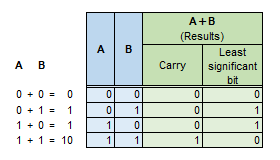
Example of binary addition
In binary addition, the least significant bit can be expressed by the logical operation “((NOT A) AND B) OR (A AND (NOT B)),” while the carry bit is given by “A AND B.”
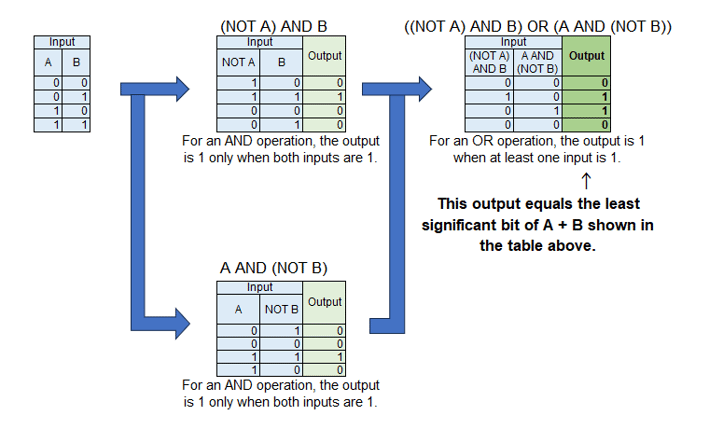
Example of representing binary addition using logical operations
Definition and Types of Logic Semiconductors
As mentioned in the previous section, logic semiconductors are integrated circuits (ICs) that implement logic circuits. They are ICs that take inputs, perform logical operations, and output the results. The level of integration is not a defining factor. Although advances in miniaturization have increased integration density and made it possible to incorporate a large number of elements, they remain combinations of basic logic circuits at their core.
People sometimes describe logic semiconductors as the components that serve as the “brains” of electronic products such as computers and smartphones—components commonly referred to as CPUs, GPUs, or processors. Strictly speaking, it is not quite accurate. These components are indeed logic semiconductors, but they are not the only ones. The proposition “Semiconductors that serve as the brains of electronic products such as computers and smartphones are logic semiconductors” is correct. However, the statement “Logic semiconductors are the semiconductors that serve as the brains of such systems and are referred to as CPUs, GPUs, or processors” is incorrect. The converse, however, is not necessarily true; logically speaking, it is incorrect. Well, since CPUs, GPUs, and processors are currently attracting the most attention, I assume this explanation is given with that understanding in mind.
The first logic semiconductors to appear were likely the standard logic ICs that emerged in the 1960s, shortly after the invention of the integrated circuit in the late 1950s, as mentioned in the previous section. These were general purpose products with a low level of integration consisting of the basic logic operations introduced earlier—AND, OR, and NOT—and combinations of these. Although they appear to have a low level of integration by today’s standards, they were undoubtedly cutting edge at the time. Standard logic ICs continue to be manufactured and sold today.
Subsequent improvements in integration density led to the emergence of one or more large-scale integrated circuits (LSIs) that integrated the logic circuits specific to each piece of equipment, which had previously been built from standard logic ICs. The calculator LSI discussed in Volume 4 is one such example. Since this approach involves creating dedicated logic semiconductors for each individual type of equipment, the number of product types can, in an extreme sense, be considered virtually limitless.
While methods for efficiently developing limitless dedicated logic semiconductors were being developed, a different approach emerged. Instead of creating dedicated logic semiconductors, computer techniques were applied to logic semiconductors. This led to the development of general-purpose logic semiconductors that can be adapted to a wide range of applications by modifying software (programs). These are called microprocessors.
Broadly speaking, it can be said that logic semiconductors fall into three categories: standard logic ICs for general use; dedicated logic semiconductors; and general-purpose logic semiconductors that can be customized through programming (microprocessors). More specifically, dedicated logic semiconductors fall into two groups: those designed for specific pieces of equipment and those designed for specific applications.
However, as miniaturization has advanced and higher levels of integration have become possible, products combining microprocessors and dedicated logic semiconductors on the same chip have emerged. In addition, microprocessors tailored for specific applications have appeared. As a result, it is not easy to make a clear-cut classification.
Note: I have been using the terms “CPU,” “GPU,” “processor,” and “microprocessor” without defining them. I will explain these terms in the next post.
Advanced Logic Semiconductors
This term has recently become common in news reports. As mentioned earlier, logic semiconductors are integrated circuits designed to implement logic circuits, regardless of their level of integration. However, the term “advanced logic semiconductors” generally refers to highly integrated, high functionality, high performance logic semiconductors manufactured using cutting edge fabrication technologies, namely advanced process nodes. That said, the boundary between what is considered “advanced” and “non advanced” is not clearly defined.
Note: In Volume 17, I described the following definition of advanced logic semiconductors.
Although there is no clear definition, in this case, it refers to logic semiconductors that use advanced wafer processes. There is likewise no fixed definition of advanced wafer processes. For the purposes of this discussion, I assume the 28 nm process and beyond. Although the 28 nm process has been in mass production for more than ten years and is often regarded as a mature process, many major IDMs do not manufacture products with their own 28 nm and below processes because developing and mass-producing processes around the 28 nm process is difficult. For this reason, I refer to it as an advanced process here.
Here are some terms (product names) that are commonly used in discussions about advanced logic semiconductors.
These include processors, microprocessors, CPUs, MPUs, GPUs, MCUs (microcontrollers), and SoCs. All of these are products related to computing. In addition, FPGAs, which were discussed in Volume 5—especially large scale devices—, and application specific integrated circuits (ASICs) used for cryptocurrency mining, which attracted attention at one time, are also considered advanced logic semiconductors.
Explanation of Abbreviations
CPU: Central Processing Unit
MPU: Microprocessor Unit
GPU: Graphics Processing Unit
MCU: Microcontroller Unit
SoC: System on a Chip or System on Chip
FPGA: Field Programmable Gate Array
ASIC: Application-Specific Integrated Circuit
That’s all for now. In the next post, I will begin by looking at the term “processor,” which appears to have the broadest scope of application.
Click below to read this series.
Semiconductor Miniaturization:
Volume 1: Semiconductor Miniaturization: What is Moore’s Law?
Volume 2: Semiconductor Miniaturization and Manufacturing Process
Volume 3: Semiconductor Miniaturization and International Technology Roadmap
Volume 4: Semiconductor Miniaturization and Semiconductor Business
Volume 5: Semiconductor Miniaturization and Semiconductor Business (Part 2)
Volume 6: Semiconductor Miniaturization and Semiconductor Devices
Volume 7: Semiconductor Miniaturization: What is MOSFET Scaling?
Volume 8: Semiconductor Miniaturization: Limitations of MOSFET Scaling
Volume 9: Semiconductor Miniaturization and Analog Circuits
Shift to Larger Diameter Silicon Wafers:
Volume 10: Shift to Larger Diameter Silicon Wafers: How a Common Material, Silicon, Became a Main Player
Volume 11: Shift to Larger Diameter Silicon Wafers (Part 2): How Silicon Wafers Are Made
Volume 12: Shift to Larger Diameter Silicon Wafers (Part 3): Reasons and History
Horizontal Specialization in the Semiconductor Industry
Volume 13: Horizontal Specialization in the Semiconductor Industry and the Rise of Fabless Companies
Volume 14: History of Horizontal Specialization in the Semiconductor Industry–Emergence of Fabless Semiconductor Companies
Volume 15: History of Horizontal Specialization in the Semiconductor Industry–Emergence of Foundries
Volume 16: Horizontal Specialization in the Semiconductor Industry—Is a Foundry Just a Subcontractor?
Volume 17: Horizontal Specialization in the Semiconductor Industry—Horizontal Specialization by Product and Country (Part 1)
Volume 18: Horizontal Specialization in the Semiconductor Industry—Horizontal Specialization by Product and Country (Part 2: By Country)
Volume 19: Miniaturization and Horizontal Specialization in the Semiconductor Industry (Special): Roots, Definitions, and Types of Advanced Logic Semiconductors


Comment